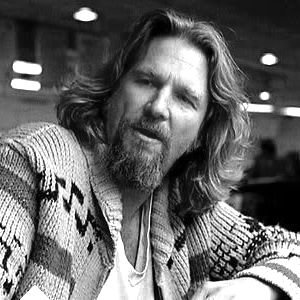

Jeff Lebowski is ... the Dude. Vestibulum id ligula porta felis euismod semper. Maecenas sed diam eget risus varius blandit sit amet non magna. Curabitur blandit tempus porttitor.

More >

Powered by Squarespace
  • The Big Lebowski (Limited Edition) [Blu-ray Book + Digital Copy]
    The Big Lebowski (Limited Edition) [Blu-ray Book + Digital Copy]
    starring Jeff Bridges, John Goodman
  • The Big Lebowski (Widescreen Collector's Edition)
    The Big Lebowski (Widescreen Collector's Edition)
    starring Jeff Bridges, John Goodman, Julianne Moore, Steve Buscemi, David Huddleston
  • The Big Lebowski - 10th Anniversary Limited Edition
    The Big Lebowski - 10th Anniversary Limited Edition
    starring Jeff Bridges, John Goodman, Julianne Moore, Steve Buscemi, David Huddleston
Sunday
Feb102008

Could the Interruption Economy Sack Prosperity?

Sensory Overload by dav

Conventional wisdom says that technology - and nowadays the Internet - will always continue to advance and bring with it productivity gains and prosperity. That's certainly been the case for years. However, historically there are pauses. After the benefits of the Industrial Revolution were fully realized it took awhile for the next big era to begin. I wonder if we're about to enter a similar lull now that the Information Age is arguably almost 30 years old.

Mark Cuban argues that the Internet is now becoming a hinderance to our productivity. Idris Moote makes an even stronger case. He notes that productivity growth has gradually slowed since 2004. Moote cites statistics showing that interruptions from e-mail, cell phones, instant messaging, and blogs take up nearly 30% of each day; on an annualized basis, this represents a loss of 28 billion hours for the entire US workforce.

The United States - and other pockets of the developed world - are hooked on two drugs: information and busyness. As I've written many times, our rush to keep up with inputs can't scale and this may cause a sizable number of people to eventually cut back on info-crack, perhaps drastically.

The runaway success of my good friend Tim Ferriss' book, the Four Hour Workweek, is a direct manifestation of a desire that millions secretly have. If enough people get the willpower to say "enough" then spending on gadgets and time spent online could decline. In a worst case scenario, companies would retrench R&D spending and slow innovation. That's just one possibility of many, of course - and the most extreme (and unlikely).

The X factor here is actually a Y factor - Generation Y. They grew up in an age of information saturation. Gen Y'ers crave what psychiatrist Edward Hallowell calls screen sucking. The Internet is in their veins. They know no other way.

I am hopeful that as every successive generation emerges that never knew a world without the Net, the possibility for such a doomsday scenario decreases. That's not to say there won't be pain however. An informal digital divide has emerged between geeks and those who are blissfully and decidedly low tech. However, it's clear that we need new tools for managing interruptions - and they may not be technological, but social. Our prosperity may depend on it.

Sunday
Feb102008

Reader Survey

This blog is going to be four years old in April. I have always viewed it as a work in progress and am eager to learn how to make it even more valuable for you.

So, using the new Google Forms feature, I have set up a quick survey that I hope will guide content going forward. I would appreciate it if you fill it out. It's anonymous and all of eight questions, most of which are multiple choice.

Thanks for reading as always.

Wednesday
Feb062008

links for 2008-02-07

Wednesday
Feb062008

The Digital Curator in Your Future

Credit: Met by jesst7

Content: it's everywhere. Content is in your inbox, your feed reader, outdoor media, your living room, your pocket and, increasingly, on every web site you visit. It also increasingly resides on sites built and managed by your favorite brands, which are bypassing the media and going direct.

The democratization of publishing is without a doubt a revolution. When we're all dead and gone, the 21st Century will be remembered as a Digital Renaissance - one that rivals the original that preceded it by 700 years.

The Internet has empowered billions of people and is distributing their creativity across millions of niches and dozens of formats. Quality and accuracy, of course, can vary. However, virtually every subject either is or will be addressed with excellence - by someone, somewhere.

However, the glut of content as we all know also has a major downside. Our information and entertainment options greatly outweigh the time we have to consume it. Even if one were to only focus on micro-niche interests and snack on bite-sized content, demand could never ever scale to match the supply. Content is a commodity. The Attention Crash is real and - make no mistake - it will deepen.

Enter the Digital Curator. A curator, in a cultural institution context, is a guardian or an overseer. According to Wikipedia, he/she "is a content specialist responsible for an institution's collections and their associated collections catalogs. The object of a curator's concern necessarily involves tangible objects of some sort, whether it be inter alia artwork, collectibles, historic items or scientific collections."

Museum curators, like web users, are faced with choices. They can't put every work of art in a museum. They acquire pieces that fit within the tone, direction and - above all - the purpose of the institution. They travel the corners of the world looking for "finds." Then, once located, clean them up and make sure they are presentable and offer the patron a high quality experience.

Much the same, the digital realm too needs curators. Information overload makes it difficult to separate junk from art. It requires a certain finesse and expertise - a fine tuned, perhaps trained eye. Google, memetrackers such as Techmeme and social news sites like digg are not curators. They're aggregators - and there's a big difference.

The call of the curator requires people who are selfless and willing to act as sherpas and guides. They're identifiable subject matter experts who dive through mountains of digital information and distill it down to its most relevant, essential parts. Digital Curators are the future of online content. Brands, media companies and dedicated individuals can all become curators. Further, they don't even need to create their own content, just as a museum curator rarely hangs his/her own work next to a Da Vinci. They do, however, need to be subject matter experts.

Curators are not editors either. The notion of an editor inherently implies that space is finite. Online it's not. Curators don't need to necessarily be trained in cutting, but in knowing where and how to unearth those special high-quality "finds" and to make them presentable. It's just as much about the experience and the way the information is presented, as it is the content.

If you look for them, curators are everywhere. Mahalo is a thriving community of curators on virtually dozens of subjects. The tech section of the New York Times web site and the My Times site, both of which highlight blogs, is another. Last but not least is the IAB Smartbrief. If you're interested in online marketing and have time to read only one source, this is the one to turn to because they curate.

As content universe expands and floods niches, there will always be a market for Digital Curators. The key for brands, individuals and media companies will be to identify those niches where they have deep expertise and to become the best in the world at serving them. I guarantee if you do this well and consistently, your long-term success is essentially guaranteed. And even if you do not have the energy to become a curator, you will certainly be influenced them.

Wednesday
Jan302008

links for 2008-01-31