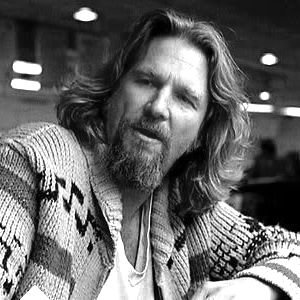

Jeff Lebowski is ... the Dude. Vestibulum id ligula porta felis euismod semper. Maecenas sed diam eget risus varius blandit sit amet non magna. Curabitur blandit tempus porttitor.

More >

Powered by Squarespace
  • The Big Lebowski (Limited Edition) [Blu-ray Book + Digital Copy]
    The Big Lebowski (Limited Edition) [Blu-ray Book + Digital Copy]
    starring Jeff Bridges, John Goodman
  • The Big Lebowski (Widescreen Collector's Edition)
    The Big Lebowski (Widescreen Collector's Edition)
    starring Jeff Bridges, John Goodman, Julianne Moore, Steve Buscemi, David Huddleston
  • The Big Lebowski - 10th Anniversary Limited Edition
    The Big Lebowski - 10th Anniversary Limited Edition
    starring Jeff Bridges, John Goodman, Julianne Moore, Steve Buscemi, David Huddleston
Thursday
Feb282008

Comparing SMM SEO and PR Tactics is Pure Poppycock

Last week I wrote about how some in the search engine optimization profession (not all) are openly espousing how to basically turn social media sites into heat seeking missiles for Google Juice - and not much else. Apparently there is a whole cottage industry called "Social Media Marketing" (SMM) that analyzes how to use social media for SEO purposes. That should give anyone pause.

Given my accusations, immediately and understandably many commenters jumped on the public relations industry for also trying to use social media to pull the wool over people's eyes. That's complete poppycock. There is no comparison. The reason is that over the last several years the PR industry has largely learned its lessons - often the hard way.

Call me an optimist, but in 2008 most in the PR business take a clean approach to social media. A key reason is that when our clients engage, their participation needs to be transparent for it to be credible. If they fail at following the common law of the community, which has happened in the past, you'll be the first to know about it. You can't always say the same so-called SMM SEO types. Their work is sometimes far harder to sleuth.

I want to discuss this a bit more by addressing some of the comments about PR that came back in response to my post...

Danny Sullivan: "the next time you're dealing with some client asking for visibility, just tell them that hey, if they have a great brand, good PR will be a byproduct."

Positive PR is definitely an outcome of good products, but not always. Public relations professionals play a key role in helping brands identify their core genius and to tell that story. The ultimate arbiter here is the public - either directly or through the media.

We always need to convince people of a product or service's worth, no matter how good it is. If we're encouraging brands to participate in social networks, blogs and social bookmark sharing sites then the bar is even higher. They must add their value before anyone will care.

Social Media Marketing through SEO, on the other hand, often aims to game the system for Google's sake. It can be difficult for someone to discern the role it played in generating Google Juice.

Aaron Wall: "Since when is a PR guy concerned about how wrong it is to game media? I mean...I spoke at a PR agency once, and their walls were plastered with framed media articles that favored their clients. How is that any different then a blogger linking to my content because they like it?"

Public relations professionals - the ones who do their job well at least - never game the media. In fact, every journalist would take issue with that statement. In the social web, the bar is even higher. If good content attracts legit blog links, then that's a completely valid approach.

Chris Kieff: I think the PR industry is just as dirty as the SEO industry. For every 8 of us good ones in both PR and SEO there are 2 lousy ones who give us all a bad name.

Every profession has people who are white hats and black hats. However, my contention is that it's very hard to uncover the nefarious SEO types while it's pretty easy to do so in PR. Fear of humiliation is acting as a deterrent in PR.

Andy Beal: "What about the multitude of PR firms that flood social media with company profiles of their clients–all with the sole intent of building their brand recognition. They want to 'appear' as if they’re engaging their customers, but really they’re just jumping in so they can figure out how to push their brand on users."

I believe these people will all be exposed if they are not adding value - period. We (the community and the industry) need to police these egregious programs, no matter where they come from. And that's happening.

Monday
Feb252008

links for 2008-02-26

Monday
Feb252008

Book Excerpt: Online Marketing Heroes

OMH_bigcover.jpg

On March 10 WIley & Sons is going to publish a new book by Michael Miller called Online Marketing Heroes: Interviews with 25 Successful Online Marketing Gurus. The book features interviews with a host of digital marketing experts, including yours truly.

Wiley has graciously approved the posting of the chapter that features an interview with me. It covers my background, thoughts on blogging, PR, digital marketing and my work at Edelman. You can download it here as a PDF.

Sound bites...

* Technology works best when it takes on a do-it-yourself character—and when it becomes free

• Google’s free search has replaced the PR professional’s traditional paid research tools.

• Generation Y is abandoning earlier technology, such as email, in favor of text messaging, instant messaging, and social network communication

• To take advantage of social networking, figure out where you andyour community overlap and how they want to communicate

• Going forward, the concept of community is the common element running through all online media and technologies

Sunday
Feb242008

An Experiment in Lifesourcing

What if you could tap into your social net (or even strangers) and ditch time intensive information tasks that you have to do in favor of the higher value stuff that you're best at? After an experiment in "lifesourcing" some work to India, I believe such a scenario might become common in the business world or even more widely - one day. Here's my story and where I think this could lead.

I first heard about lifesourcing - e.g. personal outsourcing - last summer when I read Tim Ferriss' runaway bestseller, The Four Hour Workweek. His mantra is to free yourself up to do the stuff you and only you are best at. Seth Godin covers a similar theme in The Dip.

Though it's very early, my gut says that it's conceivable that as people cope with the Attention Crash, they will zero in on their core competencies and seek to offload the rest in order to become more productive and remain competitive in the workplace. There are several forces at work here: the massive and independent-thinking Gen Y workforce, big time disruptions in IT, the growing ubiquity of social networking and peer-to-peer platforms and the rise of a giant talent pool in Chindia.

Back when I read Tim's book, I didn't see an immediate fit for lifesourcing in my day-to-day as an executive at Edelman. In fact, given that so much of what I deal with is confidential client information, it's darn near impossible.

Still, I remained extremely intrigued to run a pilot. It seems to bridge to a growing "digital nomadism" movement. For more, check out what my former colleague Mike Elgan and folks like Lea Woodward and Skellie are writing about.

My blog seemed like a natural place to dabble in lifesourcing since since pretty much everything I do here eventually enters the public domain. So, on Tim's recommendation, I posted a job on Elance. I searched for someone who could take my raw reader survey data and convert it into percentages and nice charts. This was a rather trivial assignment. However, for an Excel-challenged dude like me it was a major timesaver.

Even though the job was small, I was stunned when dozens of bids flowed in within the first few hours. The bidders seemed extremely aggressive and hungry for the job. After 24 hours of fervent bidding, I selected Sri from India based on his feedback rating, correspondence, experience and price. I also selected him because I was eager test a project with someone based in India.

After some back and forth and a bit of clarification in what I was looking for, Sri got to work. The amazing thing is that almost all of his emails came during my workday, not his. Sri turned around the job quickly and professionally and it cost me all of $50 - the Elance minimum. (I will share the charts in a subsequent post.)

Granted, this was a very simple assignment that probably anyone (but me) can do in an hour or two. Still, I was impressed. And it gets me thinking about where this might go when you combine lifesourcing and social networking - especially if the costs come down.

Social networking and online real-time communication/collaboration tools are a way of life for many Gen Yers. They already use these systems to get stuff done both inside and outside the enterprise.

Over the next five years I believe that lifesourcing will become a core part of every social network, be it b2b or b2c. Like IM or corporate blogging, social lifesourcing will start as a bottom-up movement as workers tap into the Net to get work done in the most efficient way possible, no matter where these resources may be. A groundswell may build as word spreads and workers try hard to compete with those who are farming out work elsewhere.

Still, there are big pitfalls. It's a guarantee that companies will try to put the kibosh on such activities as their information seeps beyond their virtual walls. This is already happening on social networks. Many employees have water cooler groups on Facebook. Others are dabbling in using LinkedIn to get questions answered.

It's conceivable that these interactions will migrate from simple collaboration to peer-to-peer transactions over the next few years. The implications here - if this happens en masse - are huge. People will focus on their core competencies. This in theory will make everyone more productive and prosperous. However, it remains to be seen if this will become a mass trend given all the inherent risk.

Friday
Feb222008

SEO Shenanigans Pose a Clear and Present Danger to Social Media

Unclesamwantyou.jpg

As someone who reads a lot of blogs about search and social media (a term I am still not nuts about but has stuck), I have recently witnessed a disturbing trend. Some respected experts are advocating launching social media marketing programs solely for the purpose of influencing search engines, rather than with the intent of fostering collaboration and genuine communication.

This represents a clear and present danger to the fabric of the community. If you care about the social web, then you should be alarmed.

Search engine optimization (SEO) professionals of late seem poised to take over blogs, digg, StumbleUpon and other sites with a range of tactics, some legit, others more questionable with the intent of building Google Juice and nothing more. Read these blogs and you'll see it's often all they're talking about. I am not the only one out there who feels this way.

Consider some of the following blog posts that I found in my Google Reader database...

Boost Organic Results. Link Build with Social Media (Search Engine Watch)

The Inconvienent Truth About Social Media Marketing (Search Engine Land)

Building a Company With Social Media (Search Engine Land)

Realizing SEO benefits through blogging (HitTail)

How to Use Blogs, Podcasts, Wikis and Other Social Media Tools to Find New Clients, Make Money and Create the Lifestyle of Your Dreams (Conference)

To be clear, I do not object to the way that blogs, digg links and Wikipedia rank highly in search results. What does get me hot and bothered is when consultants and bloggers propose launching such an initiatives solely for influencing search. SEO, like word of mouth, should be a byproduct outcome, not a primary objective. Any brand that plays in this space should be aiming to create value. Do that and the other stuff will follow.

But the SEO shenanigans for the sake of SEO has to stop. If you're going to play in our sandbox, follow the community's (unwritten) rules.